Toronto's Penthouse Buyers Aren't Waiting, While Everyone Else Hesitates
A 47-year-old executive just closed on a Four Seasons penthouse in 11 days. The unit two floors below her, smaller, yes, but still 2,100 square feet with unobstructed lake views, has been listed for 43 days with one price cut and zero firm offers. Same building. Same postal code. Different universes.
Sales of homes priced above $10 million in the Greater Toronto Area spiked 200% year-over-year in early 2026. That's not a recovery signal for the broader market. It's evidence of a split so clean you could graph it: the mass-market condo sector, drowning in inventory and investor exits, and the ultra-prime penthouse tier, where scarcity and velocity have never been tighter.
The gap isn't about affordability brackets. It's about supply composition. Toronto has a condo glut, but it doesn't have a quality glut. There are thousands of 600-square-foot one-bedrooms with builder-grade finishes sitting unsold. There are maybe two dozen penthouses over 3,000 square feet in marquee buildings that meet the buy-now criteria: private elevator, custom millwork, concierge who knows your name, air filtration robust enough that you never smell your neighbour's cooking.
That second category moves in under two weeks if it's priced within 8% of comps. The first category sits for six months and sells after the third reduction.
The Scarcity Premium No One Talks About
The penthouse segment isn't appreciating because Toronto real estate is "back." It's appreciating because the city built almost no oversized luxury inventory during the condo boom of 2017-2021, and the developers who are building it now can't deliver until 2028. High-net-worth buyers who want to live in Yorkville or the Financial District and don't want to maintain a 6,000-square-foot house in Bridle Path have exactly seven buildings to choose from. Four of those buildings have penthouse-tier units that come up maybe twice a year.
The velocity reflects that math. Buyers at this tier aren't comparing offers. They're making pre-emptive bids the day a unit gets whispered about in broker networks, sometimes before it hits MLS. Roughly 60-70% of $10 million-plus transactions in 2026 are estimated to involve minimal traditional financing, either all cash or structured instruments that don't care what the Bank of Canada does on Wednesday.
That insulation is the other half of the story. Entry-level condo owners are getting crushed by carrying costs: mortgage resets at rates triple what they locked in during 2020, condo fees climbing past $800/month on older stock, land transfer taxes that weren't part of the 2019 purchase model. Investors are liquidating because the rent-to-carrying-cost equation no longer works. Luxury buyers never relied on that equation. They're buying a finished product, not a yield vehicle.
Vertical Estates and the Lifestyle Shift
There's a cultural recalibration happening that the market data doesn't quite capture. Toronto's traditional wealth used to anchor in the 905 belt, Oakville, King City, the parts of Mississauga where driveways have gates. Sprawling properties. Three-car garages. Lawn services.
That's being replaced by a different status marker: the ability to walk to Alo, to skip traffic entirely, to have building security that's invisible but absolute. The penthouse tier is selling a fundamentally different product than the mansion tier, and for a narrow but growing slice of Toronto's top earners, it's the better product. Turnkey. No landscaping. No explaining to your executive assistant why you're 40 minutes late because the Gardiner was a parking lot.
The amenities premium reflects this. In 2026, a true ultra-luxury building isn't competing on marble countertops. It's competing on private air filtration, biometric entry, soundproofing robust enough that you genuinely cannot hear the floor above you, and concierge depth that goes beyond "we'll hold your packages." Those features cost serious money to spec and deliver. They also justify $3,200 per square foot when comparable non-luxury product three blocks away is stuck at $1,150.
What This Means for the Rest of the Market
None of this rescues the mid-tier. The $2 million to $4 million luxury band, nice finishes, good location, but not private-elevator-level exclusivity, is still experiencing real price sensitivity. Buyers in that range are comparing offers, negotiating, walking away. The penthouse run isn't trickling down because the penthouse buyer and the $3 million buyer aren't solving the same problem.
The split will likely widen before it narrows. New luxury supply won't hit the market in volume until 2028 or later, and most of that pipeline is pre-sold. The existing penthouse stock will stay tight. Meanwhile, the broader condo market has to absorb thousands of investor-owned units being dumped into a buyer's market where financing costs remain a hard ceiling on what people can carry.
Toronto's real estate market isn't recovering. It's bifurcating. And the half that's winning was never part of the cycle everyone else is still trying to time.

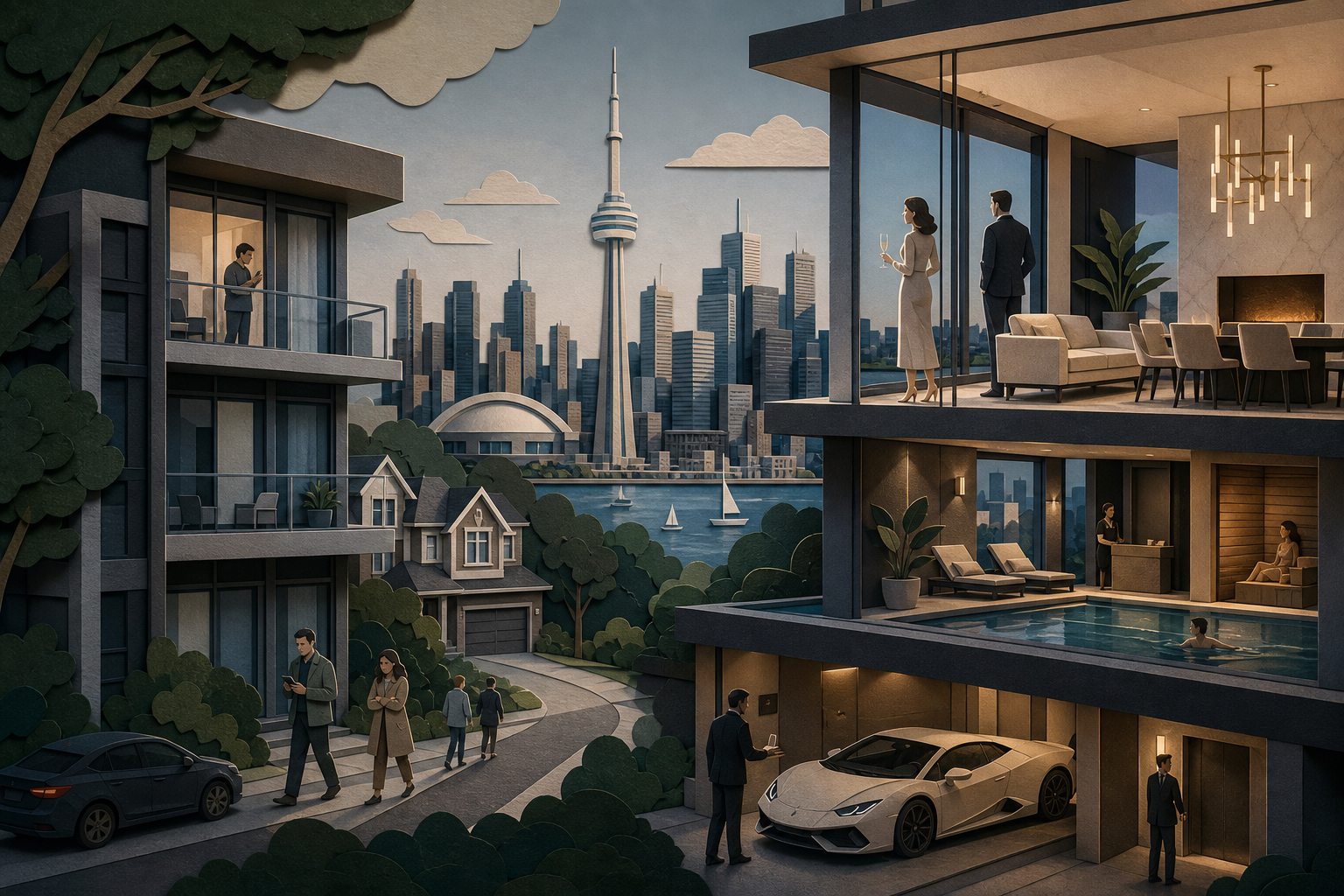

A 47-year-old executive just closed on a Four Seasons penthouse in 11 days. The unit two floors below her, smaller, yes, but still 2,100 square feet with unobstructed lake views, has been listed for 43 days with one price cut and zero firm offers. Same building. Same postal code. Different universes.
Sales of homes priced above $10 million in the Greater Toronto Area spiked 200% year-over-year in early 2026. That's not a recovery signal for the broader market. It's evidence of a split so clean you could graph it: the mass-market condo sector, drowning in inventory and investor exits, and the ultra-prime penthouse tier, where scarcity and velocity have never been tighter.
The gap isn't about affordability brackets. It's about supply composition. Toronto has a condo glut, but it doesn't have a quality glut. There are thousands of 600-square-foot one-bedrooms with builder-grade finishes sitting unsold. There are maybe two dozen penthouses over 3,000 square feet in marquee buildings that meet the buy-now criteria: private elevator, custom millwork, concierge who knows your name, air filtration robust enough that you never smell your neighbour's cooking.
That second category moves in under two weeks if it's priced within 8% of comps. The first category sits for six months and sells after the third reduction.
The Scarcity Premium No One Talks About
The penthouse segment isn't appreciating because Toronto real estate is "back." It's appreciating because the city built almost no oversized luxury inventory during the condo boom of 2017-2021, and the developers who are building it now can't deliver until 2028. High-net-worth buyers who want to live in Yorkville or the Financial District and don't want to maintain a 6,000-square-foot house in Bridle Path have exactly seven buildings to choose from. Four of those buildings have penthouse-tier units that come up maybe twice a year.
The velocity reflects that math. Buyers at this tier aren't comparing offers. They're making pre-emptive bids the day a unit gets whispered about in broker networks, sometimes before it hits MLS. Roughly 60-70% of $10 million-plus transactions in 2026 are estimated to involve minimal traditional financing, either all cash or structured instruments that don't care what the Bank of Canada does on Wednesday.
That insulation is the other half of the story. Entry-level condo owners are getting crushed by carrying costs: mortgage resets at rates triple what they locked in during 2020, condo fees climbing past $800/month on older stock, land transfer taxes that weren't part of the 2019 purchase model. Investors are liquidating because the rent-to-carrying-cost equation no longer works. Luxury buyers never relied on that equation. They're buying a finished product, not a yield vehicle.
Vertical Estates and the Lifestyle Shift
There's a cultural recalibration happening that the market data doesn't quite capture. Toronto's traditional wealth used to anchor in the 905 belt, Oakville, King City, the parts of Mississauga where driveways have gates. Sprawling properties. Three-car garages. Lawn services.
That's being replaced by a different status marker: the ability to walk to Alo, to skip traffic entirely, to have building security that's invisible but absolute. The penthouse tier is selling a fundamentally different product than the mansion tier, and for a narrow but growing slice of Toronto's top earners, it's the better product. Turnkey. No landscaping. No explaining to your executive assistant why you're 40 minutes late because the Gardiner was a parking lot.
The amenities premium reflects this. In 2026, a true ultra-luxury building isn't competing on marble countertops. It's competing on private air filtration, biometric entry, soundproofing robust enough that you genuinely cannot hear the floor above you, and concierge depth that goes beyond "we'll hold your packages." Those features cost serious money to spec and deliver. They also justify $3,200 per square foot when comparable non-luxury product three blocks away is stuck at $1,150.
What This Means for the Rest of the Market
None of this rescues the mid-tier. The $2 million to $4 million luxury band, nice finishes, good location, but not private-elevator-level exclusivity, is still experiencing real price sensitivity. Buyers in that range are comparing offers, negotiating, walking away. The penthouse run isn't trickling down because the penthouse buyer and the $3 million buyer aren't solving the same problem.
The split will likely widen before it narrows. New luxury supply won't hit the market in volume until 2028 or later, and most of that pipeline is pre-sold. The existing penthouse stock will stay tight. Meanwhile, the broader condo market has to absorb thousands of investor-owned units being dumped into a buyer's market where financing costs remain a hard ceiling on what people can carry.
Toronto's real estate market isn't recovering. It's bifurcating. And the half that's winning was never part of the cycle everyone else is still trying to time.
Read Next
BC Homeowners: Three Moves That Cut Your 2026 Renewal Payment Before You Sign
What Americans Forget When Buying Canadian Real Estate: 4 Cross-Border Tax Rules That Cost Thousands
Why Metro Vancouver's 22% Inventory Spike Creates a Closing Window for Upsizing
Capital Group Canada enters active ETF race with five equity launches